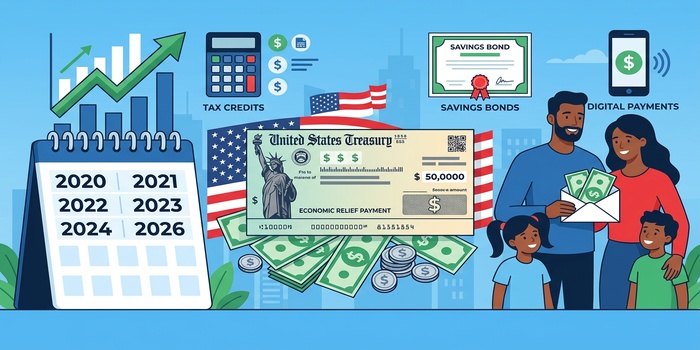
A complete guide to the history of federal stimulus checks in the United States, why no new federal stimulus is being sent in 2026, the truth about tariff rebate proposals, and the financial aid programs that are actually available right now.
⚠️ Important: No New Federal Stimulus Check in 2026
As of 2026, there is no active federal stimulus check program. The three rounds of Economic Impact Payments (EIP) issued during 2020–2021 have ended. The deadline to claim missing payments through the Recovery Rebate Credit passed on April 15, 2025. Be cautious of any website, social media post, or text message promising a “new federal stimulus” — these are almost always scams or misinformation.
⚡ TL;DR — What You Need to Know
Federal stimulus checks (2020–2021): Three rounds were issued. They are over. The deadline to claim missing payments expired April 15, 2025.
Tariff rebate check ($2,000): Proposed by President Trump in late 2025, but as of 2026 it has not been approved by Congress. It is not currently being sent.
What IS available in 2026: Child Tax Credit ($2,200/child), Earned Income Tax Credit (EITC), state-level tax rebates in ~17 states, SNAP, SSI/SSDI, unemployment insurance, and more.
📑 Table of Contents
- A Brief History of US Stimulus Checks (2020–2021)
- First Stimulus Check — CARES Act ($1,200)
- Second Stimulus Check — December 2020 ($600)
- Third Stimulus Check — American Rescue Plan ($1,400)
- Why There Are No More Federal Stimulus Checks in 2026
- Recovery Rebate Credit — Deadline Has Passed
- The $2,000 Tariff Rebate Check Proposal — Status in 2026
- What Financial Aid IS Available in 2026
- State-Level Stimulus and Tax Rebates in 2026
- How to Spot Stimulus Check Scams
- Frequently Asked Questions
- Official Resources
1. A Brief History of US Stimulus Checks (2020–2021)
The United States issued three rounds of Economic Impact Payments (commonly known as “stimulus checks”) in response to the economic disruption caused by the COVID-19 pandemic. These payments were administered by the Internal Revenue Service (IRS) and were designed to provide direct financial relief to American households.
In total, the federal government distributed more than $814 billion in stimulus payments to over 165 million Americans across the three rounds. After the third round in 2021, no additional federal stimulus checks have been issued.
2. First Stimulus Check — CARES Act ($1,200)
The first round of stimulus payments was authorized by the Coronavirus Aid, Relief, and Economic Security (CARES) Act, signed into law on March 27, 2020.
Key Details
- Amount: Up to $1,200 per eligible adult, plus $500 per qualifying child under 17.
- Income limits: Full payment for individuals earning under $75,000 (or $150,000 for married couples filing jointly). Reduced amounts for higher incomes, phasing out completely at $99,000 for individuals and $198,000 for couples.
- Distribution: Began in April 2020. Most payments were issued by direct deposit; others received paper checks or EIP debit cards.
- Total distributed: Approximately $292 billion to 160+ million Americans.
3. Second Stimulus Check — December 2020 ($600)
The second round of payments was authorized by the Consolidated Appropriations Act, 2021, signed on December 27, 2020.
Key Details
- Amount: Up to $600 per eligible adult, plus $600 per qualifying child under 17.
- Income limits: Same thresholds as the first round ($75,000 single / $150,000 married).
- Distribution: Began late December 2020 and continued through January 2021.
- Total distributed: Approximately $164 billion.
4. Third Stimulus Check — American Rescue Plan ($1,400)
The third and final round of stimulus checks was authorized by the American Rescue Plan Act, signed by President Biden on March 11, 2021.
Key Details
- Amount: Up to $1,400 per eligible adult, plus $1,400 per qualifying dependent (including adult dependents — a key change from earlier rounds).
- Income limits: Full payment for individuals earning under $75,000 (or $150,000 for married couples). Phased out completely at $80,000 (single) and $160,000 (married).
- Distribution: Began March 2021 and continued throughout the year.
- Total distributed: Approximately $400 billion to over 175 million people.
📌 Key Takeaway
The third stimulus check was the last federal stimulus payment issued. Since 2021, no new round of federal Economic Impact Payments has been approved by Congress, despite occasional proposals.
5. Why There Are No More Federal Stimulus Checks in 2026
Many Americans continue to ask whether a “fourth stimulus check” or new federal payment is coming. The short answer is no. Here’s why:
- The pandemic emergency officially ended. The federal public health emergency for COVID-19 expired on May 11, 2023. The economic justification for emergency direct payments no longer exists.
- No new stimulus legislation has been passed. Despite various bills being introduced in Congress (including proposals for $2,000 monthly checks and one-time pandemic-era extensions), none have advanced to a vote.
- Inflation and budget concerns. Lawmakers have shifted focus toward deficit reduction and inflation control, making broad direct-payment programs politically difficult.
- Targeted aid replaces broad stimulus. Recent federal action has favored targeted programs (expanded EITC, Child Tax Credit changes, energy rebates) over universal stimulus payments.
If you see headlines or social media posts claiming a “new federal stimulus check is on the way,” verify the information directly with the IRS before believing or sharing it.
6. Recovery Rebate Credit — The Deadline Has Passed
If you missed one or more of the three stimulus checks, the IRS allowed you to claim them through the Recovery Rebate Credit on your tax return. However, this option is no longer available.
⏰ Deadline Expired: April 15, 2025
The deadline to file a 2021 tax return and claim the Recovery Rebate Credit for the third $1,400 stimulus check expired on April 15, 2025. The deadlines for claiming the first and second stimulus checks (via 2020 tax returns) expired even earlier, on May 17, 2024.
After April 15, 2025, the IRS no longer accepts claims for missing stimulus payments. If you did not file by that date, the unclaimed funds were returned to the U.S. Treasury and can no longer be recovered.
What If I Never Received a Stimulus Check and Missed the Deadline?
Unfortunately, there is no longer a way to claim the original federal stimulus checks if you missed the IRS deadlines. However, you may still be eligible for other forms of federal or state assistance — see the alternatives section below.
7. The $2,000 Tariff Rebate Check Proposal — Status in 2026
In late 2025, President Donald Trump proposed sending a $2,000 “tariff dividend” or “tariff rebate check” to American taxpayers, funded by revenue collected from import tariffs. This proposal generated significant media attention and public interest throughout late 2025 and early 2026.
Current Status (As of 2026)
- Not yet approved. As of 2026, no tariff rebate check has been signed into law. Several bills have been introduced in Congress to authorize such payments, but none have passed both chambers.
- Legal and budgetary questions remain. Tariff revenue is currently directed to the U.S. Treasury, and redirecting it to direct payments would require new legislation. Economic analysts have also raised concerns about the actual amount of available tariff revenue.
- No official IRS guidance. The IRS has not issued any guidance, eligibility rules, or distribution timeline for a tariff rebate, because the program does not legally exist yet.
⚠️ Be Cautious of Misinformation
Because the tariff rebate check has been heavily discussed in news and social media, scammers have created fake websites, text messages, and emails claiming to “register” people for a payment that does not yet exist. The IRS will never ask you to register for a stimulus or rebate via text, email, or social media. Only trust information from irs.gov and other official .gov sources.
Will the Tariff Rebate Be Approved Eventually?
It is impossible to predict whether the tariff rebate proposal will pass Congress, be modified, or be abandoned entirely. We will update this guide if and when official legislation is signed into law. In the meantime, do not count on a tariff rebate check as part of your financial planning.
8. What Financial Aid IS Available in 2026
While there is no federal stimulus check in 2026, several federal and state programs are still actively providing financial assistance to eligible Americans. Here are the most important ones:
Child Tax Credit (CTC) — Up to $2,200 per child
For tax year 2026, the federal Child Tax Credit is worth up to $2,200 per qualifying child under 17 (increased from $2,000 in tax year 2025). Up to $1,700 of that amount is refundable, meaning you can receive it as a refund even if you owe little or no income tax.
- Income limits: Full credit for individuals earning under $200,000 (or $400,000 for married couples filing jointly).
- How to claim: File your federal tax return (Form 1040) and include Schedule 8812.
- Official source: IRS Child Tax Credit page.
Earned Income Tax Credit (EITC) — Up to $7,830
The Earned Income Tax Credit is a refundable tax credit for low- and moderate-income working individuals and families. For tax year 2025, the maximum credit is up to $7,830 for families with three or more children.
- Eligibility: You must have earned income from work and meet income thresholds (which vary based on family size).
- How to claim: File your federal tax return and use the EITC worksheet or tax software.
- Official source: IRS EITC page.
Unemployment Insurance
If you have lost your job through no fault of your own, you may be eligible for unemployment insurance benefits. Each state administers its own program with different benefit amounts and eligibility rules.
- California unemployment guide
- New York unemployment guide
- New Jersey unemployment guide
- Illinois unemployment guide
SNAP (Food Stamps)
The Supplemental Nutrition Assistance Program (SNAP) provides monthly benefits to help low-income individuals and families buy groceries. Eligibility and benefit amounts vary based on household size, income, and state. Apply through your state SNAP agency.
Social Security (SSI / SSDI)
Supplemental Security Income (SSI) and Social Security Disability Insurance (SSDI) provide monthly payments to eligible individuals who are 65 or older, blind, or disabled. Apply through the Social Security Administration.
Other Federal and State Assistance
- LIHEAP: Help with home heating and cooling bills.
- Section 8 / Housing Choice Voucher: Rental assistance for low-income households.
- Medicaid / CHIP: Health insurance for low-income individuals and children.
- WIC: Nutrition assistance for women, infants, and children.
For a complete list of federal benefit programs, visit Benefits.gov.
9. State-Level Stimulus and Tax Rebates in 2026
While there is no federal stimulus check, roughly 17 states have issued or are currently issuing their own tax rebates, inflation relief payments, or “state stimulus checks” in 2026. These programs are funded by state budget surpluses and have their own eligibility rules.
Examples of states with active or recent rebate programs include New York (inflation refund), California (Middle Class Tax Refund follow-ups), Colorado (TABOR refund), Pennsylvania (Property Tax/Rent Rebate), and several others. Eligibility, amounts, and deadlines vary significantly.
💡 How to Check Your State
Search “[your state] tax rebate 2026” on Google or visit your state’s Department of Revenue or Department of Taxation website. Be cautious: only trust official .gov websites for state rebate information.
10. How to Spot Stimulus Check Scams
Because public interest in stimulus checks remains high, scammers actively use the topic to defraud people. Here are common warning signs:
- Texts or emails asking you to “register” or “claim” a stimulus. The IRS does not contact taxpayers via text, email, or social media to request personal information.
- Requests for fees to receive a stimulus. Federal and state stimulus programs are always free. You should never pay a fee to receive a payment.
- Fake government websites. Always verify that the URL ends in .gov (e.g., irs.gov, ssa.gov). Scammers often create lookalike sites with similar names.
- Promises of “guaranteed” payments. No legitimate program guarantees a payment without verifying eligibility through official channels.
- Pressure to act fast. Scammers often create false urgency. Real federal programs allow reasonable time to apply.
If you receive a suspicious message, report it to the IRS at irs.gov/privacy-disclosure/report-phishing or to the FTC at reportfraud.ftc.gov.
11. Frequently Asked Questions
Is there a fourth stimulus check coming in 2026?
No. As of 2026, there is no federal fourth stimulus check approved or scheduled. While various proposals have been introduced in Congress, none have been signed into law.
What about the $2,000 tariff rebate check proposed by Trump?
The $2,000 tariff rebate check is a proposal that has not been approved by Congress. As of 2026, no such payment is being sent. The IRS has issued no guidance on it because the program does not legally exist yet.
Can I still claim a missing stimulus check from 2020 or 2021?
No. The deadline to claim missing stimulus payments through the Recovery Rebate Credit expired on April 15, 2025 (for the third $1,400 payment) and earlier for the first two payments. Unclaimed funds have been returned to the U.S. Treasury.
Are there any monthly stimulus payments available?
The federal government does not offer recurring monthly “stimulus” payments. However, recurring monthly assistance is available through programs like SSI, SSDI, SNAP, and TANF for those who qualify.
What’s the difference between a stimulus check and a tax credit?
A stimulus check is a direct payment sent to eligible individuals, usually outside the tax filing process. A tax credit (like the Child Tax Credit or EITC) reduces the amount of taxes you owe and may result in a refund — but you must file a tax return to claim it.
Will Social Security recipients get a new stimulus check in 2026?
No new federal stimulus is being sent specifically to Social Security recipients in 2026. However, Social Security beneficiaries did receive a Cost-of-Living Adjustment (COLA) for 2026, which increases their monthly benefit. Visit ssa.gov/cola for current rates.
Where can I get reliable information about future stimulus or rebate programs?
Always check official government sources first: IRS.gov for federal tax-related programs, your state’s Department of Revenue for state rebates, and Benefits.gov for a directory of federal assistance programs.
Are there any pandemic-era benefits still available?
Most pandemic-era programs (PUA, PEUC, FPUC, expanded Child Tax Credit advance payments) ended in 2021. The deadlines to claim retroactive benefits have also passed. The Child Tax Credit continues at a reduced level ($2,200 per child for tax year 2026), but it operates as a regular tax credit, not as monthly advance payments.
12. Official Resources
For accurate, up-to-date information about federal financial assistance programs, always rely on official sources:
- IRS — Economic Impact Payments page: Official record of all three stimulus rounds.
- IRS — Child Tax Credit: Eligibility and amounts for the current tax year.
- IRS — Earned Income Tax Credit: Eligibility, income limits, and how to claim.
- Benefits.gov: Search tool for federal assistance programs.
- Social Security Administration: SSI, SSDI, retirement benefits.
- USDA SNAP: Food assistance program information.
Related Guides on TheUnemployment.org
- All Unemployment Guides by State
- How to Appeal an Unemployment Denial
- Unemployment Overpayment Waiver Guide
🔑 Final Takeaways
The era of federal stimulus checks (2020–2021) is over. The deadline to claim missing payments expired on April 15, 2025. As of 2026, no new federal stimulus check has been approved, including the proposed $2,000 tariff rebate.
However, real and significant financial help still exists — through the Child Tax Credit, EITC, unemployment insurance, SNAP, Social Security, state-level rebates, and more. The key is knowing which programs you qualify for and applying through official channels.
Be skeptical of any message claiming you can “register” for a new stimulus. When in doubt, verify directly with irs.gov or your state’s official .gov website.
⚠️ Legal Disclaimer
This guide is for informational purposes only and does not constitute legal, financial, or tax advice. Federal and state assistance programs change frequently. Always verify current eligibility, amounts, and deadlines with the relevant government agency before making financial decisions.
📚 Sources
- Internal Revenue Service. Economic Impact Payments. irs.gov/coronavirus/economic-impact-payments
- Internal Revenue Service. 2021 Recovery Rebate Credit Questions and Answers. irs.gov/newsroom/2021-recovery-rebate-credit-questions-and-answers
- Internal Revenue Service. Child Tax Credit. irs.gov/credits-deductions/individuals/child-tax-credit
- U.S. Department of the Treasury. Economic Impact Payments. home.treasury.gov
- Benefits.gov. Federal Benefits Directory. benefits.gov
Need Help With Unemployment or State Benefits?
Explore our complete state-by-state guides on unemployment claims, appeals, overpayment waivers, and more. We update our content regularly to reflect 2026 rules and amounts.